
Quick answer
What is the target sell price formula?
Start with Total cost basis, add the target net profit, subtract dividends, and account for the expected sell commission. Divide the amount that must come from the sale by the number of shares.
When the sell commission is a percentage, divide by Number of shares x (1 - Sell commission rate) instead. If the target is stated as ROI, first convert it into a dollar target using Total cost basis x Target ROI / 100.
Calculator walkthrough
Step 1: choose the target sell price mode
Open the stock profit calculator and select Find required sell price. Enter the shares, buy price, and commissions for the position. Then choose whether the target is a dollar Net profit or loss or a percentage Return on investment.
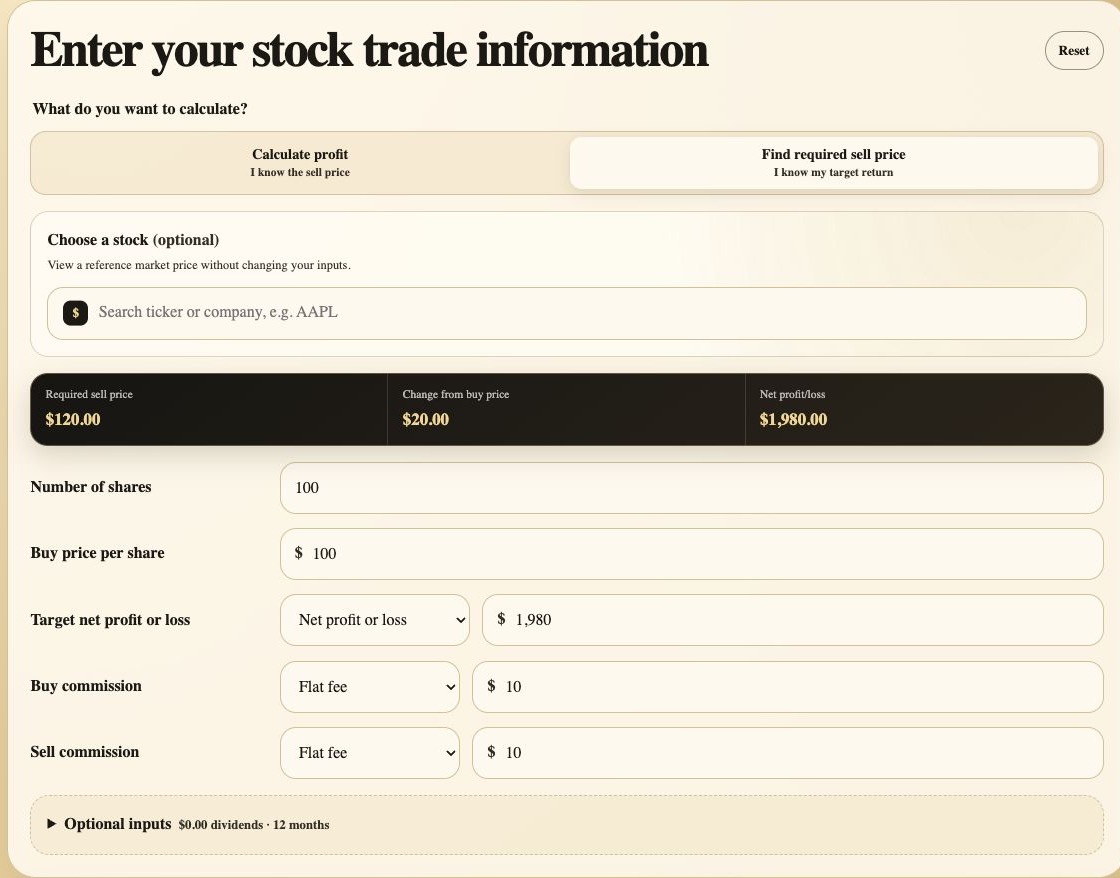
Switch calculation modes. Select Find required sell price when the desired outcome is known but the exit price is not.
Enter the target. Choose Net profit or loss for a dollar goal, then enter a positive profit or an achievable negative loss amount.
Read the live answer. The summary shows Required sell price, its difference from Buy price per share, and the Net profit or loss at that price.
Worked dollar target
Step 2: calculate a sell price for a target profit
Suppose 100 shares were purchased at $100 per share. The buy commission was $10, the expected sell commission is $10, and the target net profit is $1,980. No dividends are included.
Target profit example
The required sell price is $120.00
The calculation recovers the $10,010 Total cost basis, creates $1,980 in net profit, and leaves $10 for the sell commission. The required $12,000 gross sale value divided by 100 shares equals $120 per share.
- Purchase value
- 100 x $100 = $10,000
- Total cost basis
- $10,000 + $10 = $10,010
- Target net profit
- $1,980
- Required gross sale value
- $10,010 + $1,980 + $10 = $12,000
- Required sell price
- $12,000 / 100 = $120.00
- ROI at this price
- $1,980 / $10,010 = 19.78%
Percentage target
Step 3: calculate a sell price for a target ROI
Select Return on investment when the goal is stated as a percentage of Total cost basis. The calculator first converts the target ROI into the equivalent dollar profit, then solves for the required price using the same fee-aware calculation.
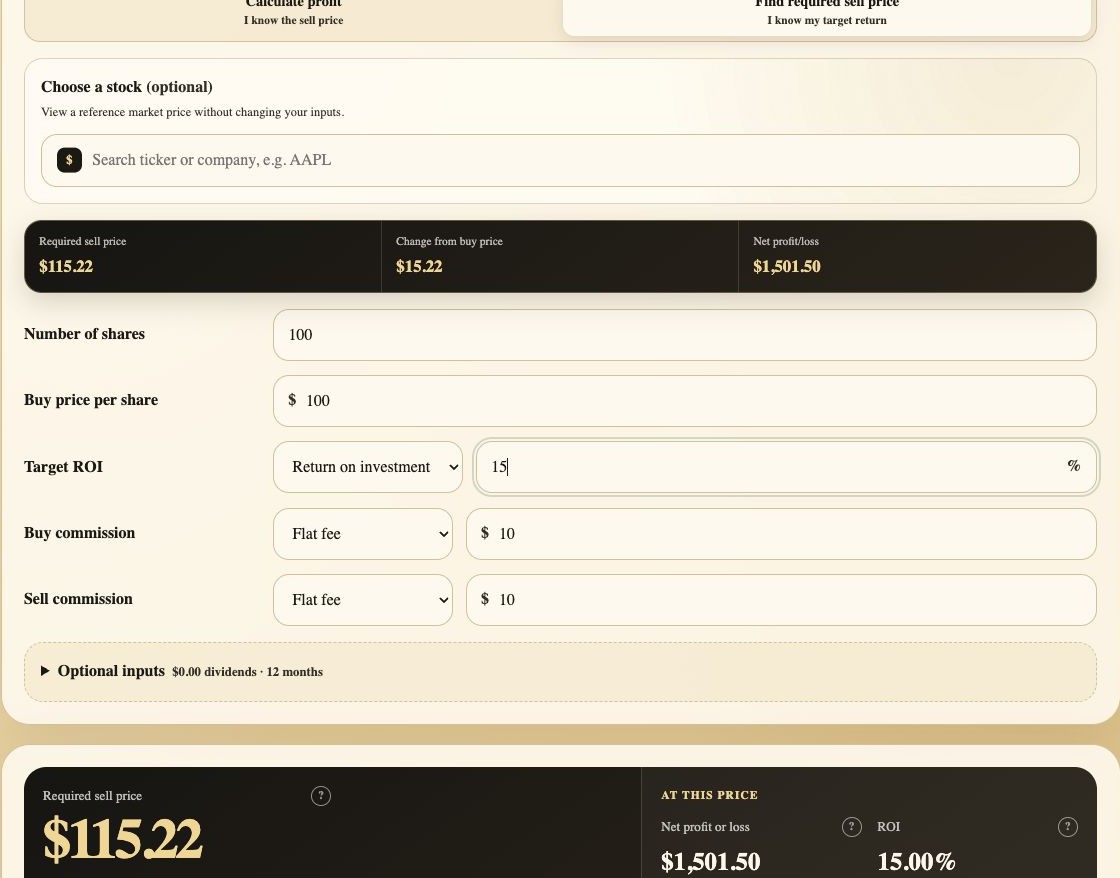
Check the required price. A 15% target ROI produces a Required sell price of $115.22 in this example.
Select Return on investment. Enter 15 for 15%, not 0.15. The calculator labels the field Target ROI and displays the percent sign.
Confirm the outcome. The result panel verifies $1,501.50 Net profit and 15.00% ROI at the calculated price.
Find target net profit
$10,010 x 15% = $1,501.50
Add basis, profit, and fee
$10,010 + $1,501.50 + $10 = $11,521.50
Divide by shares
$11,521.50 / 100 = $115.215, displayed as $115.22
| Target type | Target entered | Required sell price | Resulting Net profit or loss | Resulting ROI |
|---|---|---|---|---|
| Net profit or loss | $1,980 | $120.00 | $1,980 | 19.78% |
| Return on investment | 15% | $115.22 | $1,501.50 | 15.00% |
| Loss limit | -$500 | $95.20 | -$500 | -5.00% |
Result walkthrough
Step 4: verify the required sell price
Treat the main price as the answer to the scenario, then use the outcome, formula, and breakdown to confirm that the calculated price produces the intended target after fees.
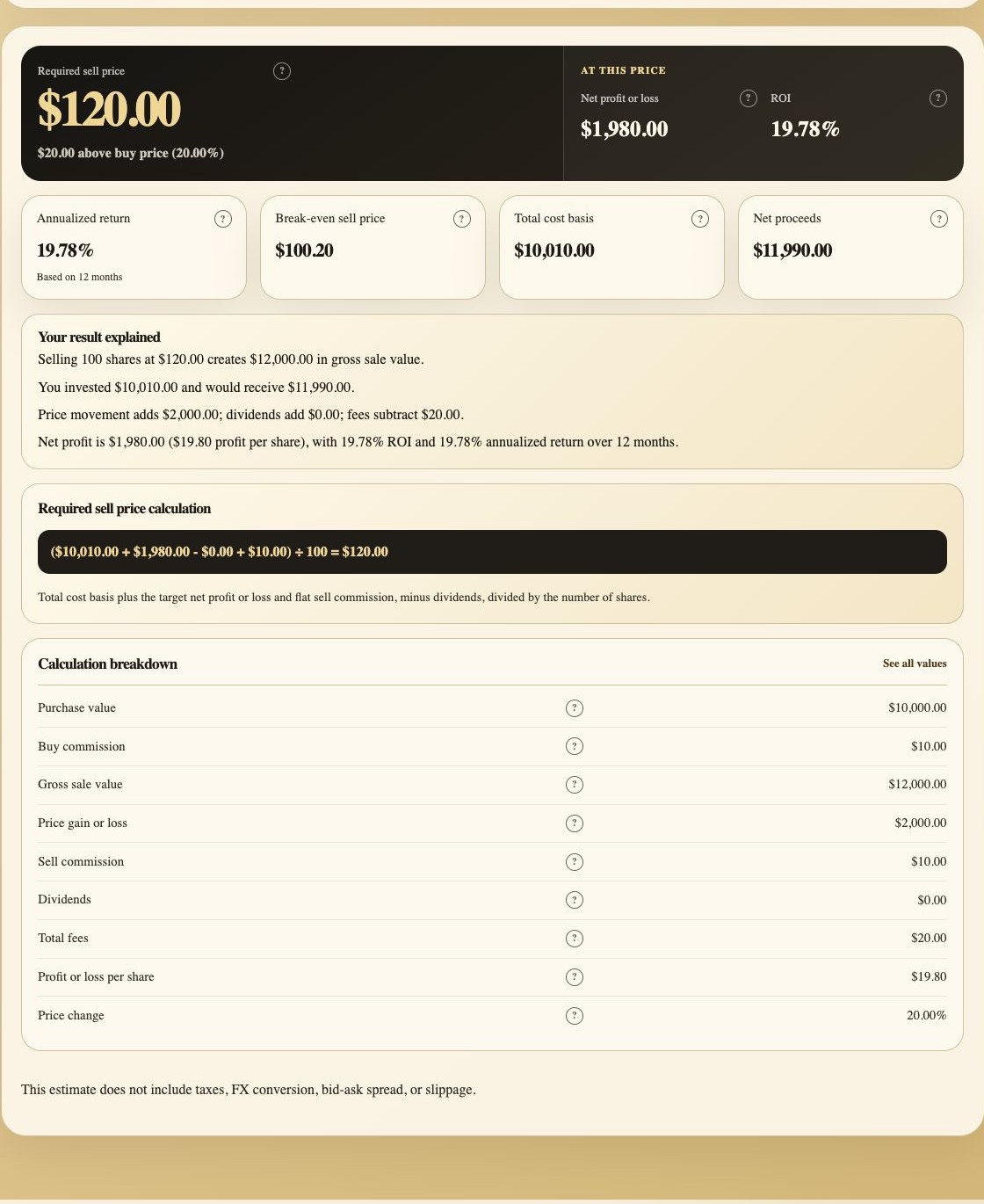
Required sell price. This is the calculated price per share needed to meet the target under the entered assumptions.
Outcome at this price. Net profit or loss and ROI confirm the result that the price is designed to produce.
Supporting metrics. Break-even sell price, Total cost basis, and Net proceeds help distinguish the target from the minimum break-even level.
Required price formula. The substituted equation shows the values used to solve for the price.
Calculation breakdown. Expand the audit trail to inspect the purchase value, both commissions, sale value, price change, and Total fees.
Scenario assumptions
How fees and dividends change the target price
A larger buy commission raises Total cost basis, so more sale proceeds are needed to reach the same target. A sell commission also raises the required gross sale value. Cash dividends move in the opposite direction because they are included in Net proceeds and reduce the amount that must come from selling the shares.
Flat sell commission
Add the expected fixed fee to the amount that the sale must produce before dividing by Number of shares.
Percentage sell commission
Divide by 1 minus the commission rate because the fee grows with the required gross sale value.
Dividends
Subtract dividends included in the scenario before solving for the amount that must come from the sale.
Negative target
A negative Net profit or loss can model an acceptable loss. The calculator rejects targets that would require a price below zero.
The target sell price is not the same as Break-even sell price. Break-even targets a $0 net result; a target sell price can be above or below break-even depending on the profit or loss goal.
If Previous sales are entered, target mode uses only the shares and cost basis remaining after those completed sales. The Required sell price applies to the current modeled sale and does not try to recover or repeat profit already recorded in Position sale history.
From calculation to market
A calculated target price is not a guaranteed execution price
The calculator answers a planning question: what price would produce the selected result if the entered assumptions hold? It does not predict whether the market will reach that price or whether an order will execute there. Quotes can move, and spread, slippage, liquidity, taxes, and unmodeled charges can change the realized result.
A sell limit order can execute only at the limit price or higher, but execution is not assured if the market does not meet the order's conditions. Review the order types and policies available through your broker before acting on a calculated scenario.
Before relying on the estimate
Common target sell price mistakes
Using a gross profit target
The target field represents Net profit or loss after the entered commissions, not price gain before costs.
Entering ROI as a decimal
Enter 15 to model a 15% ROI. Entering 0.15 means a 0.15% target.
Ignoring the sell commission
Use the fee expected when the shares are sold. Leaving it out can make the calculated price too low.
Mixing positions or currencies
Keep shares, basis, dividends, fees, and target values tied to the same position and currency. For positions built over time, see the multiple-purchase calculator guide.
Methodology and references
Planning a target without overstating certainty
The formula follows the calculator's documented treatment of Total cost basis, Net proceeds, dividends, and commissions. Investor.gov and FINRA explain that order type affects how a requested price may be handled in the market and that a limit price does not guarantee execution.
Ready to calculate the price for your own target?
Use the Stock Profit Calculator